
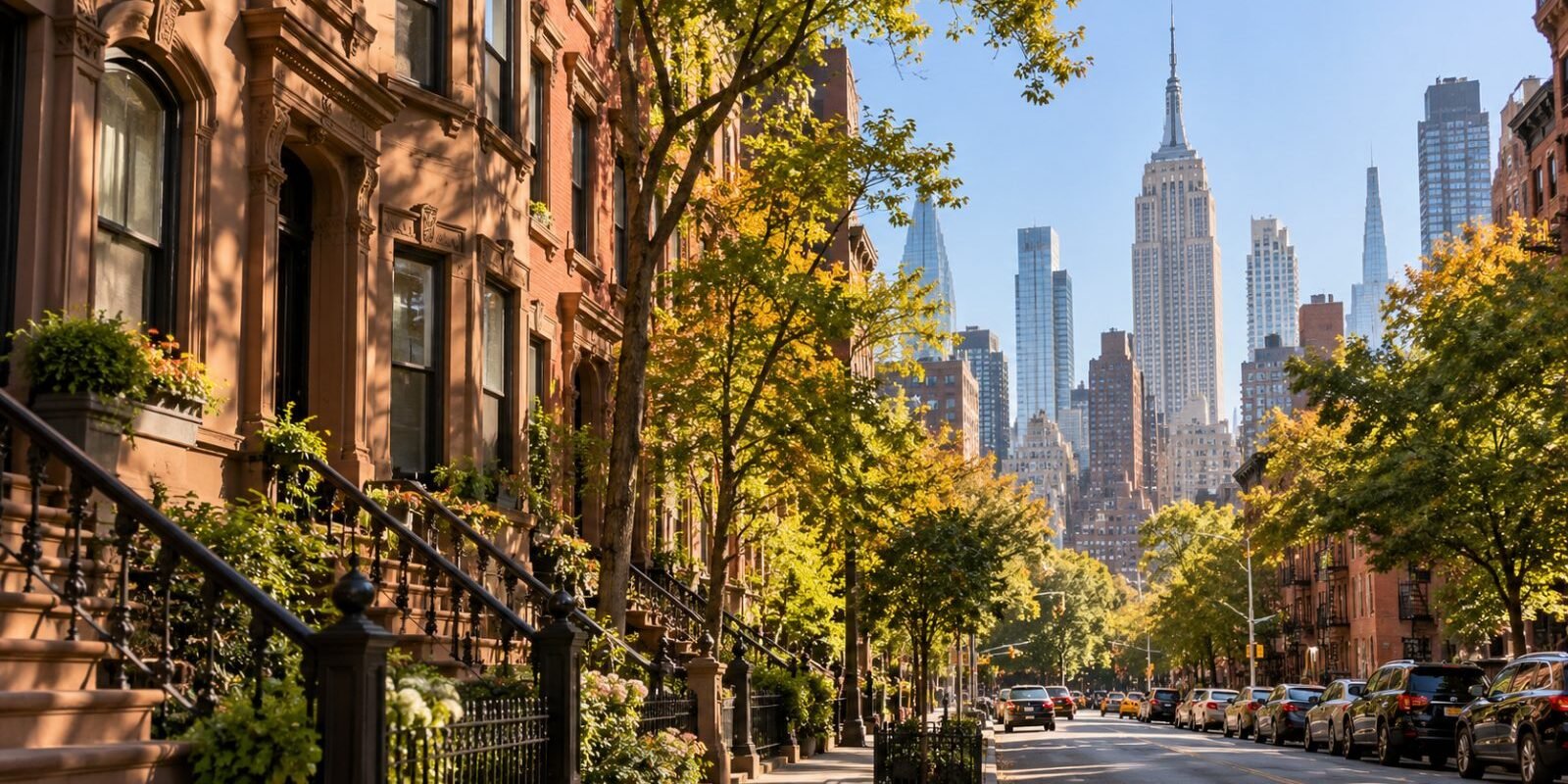
Choosing where to stay in New York is the decision that shapes your whole trip. Pick the right neighbourhood and you walk to half the sights, get home quickly after a Broadway show and save hours on the subway. Pick the wrong one and you spend your holiday commuting.
This guide compares the best areas to stay in New York City for every kind of traveller — first-timers, families, couples and budget travellers — with the subway lines that serve each area, hotels to look at in every price range, what hotels really cost month by month, and the taxes most booking sites don’t show upfront.
The best areas to stay in New York at a glance
| Area | Best for | Price level | To Times Square | Main downside |
|---|---|---|---|---|
| Midtown (Times Square, Theater District, Grand Central) | First-timers, Broadway | $$–$$$ | Walk | Crowds and noise |
| Lower Manhattan (Financial District, Tribeca) | Quiet nights, Statue of Liberty | $$–$$$ | 20–25 min subway | Quiet streets at night |
| Chelsea, Flatiron & the Village | Food, nightlife, couples | $$–$$$ | 10–15 min subway | Fewer budget hotels |
| Upper West Side | Families, Central Park | $$ | 10–15 min subway | Far from Downtown |
| Brooklyn (DUMBO, Williamsburg, Downtown) | Views, repeat visitors, nightlife | $–$$$ | 20–35 min subway | Longer rides to Midtown |
| Long Island City (Queens) | Budget, skyline views | $ | 5–15 min subway | Few sights nearby |
Subway times are our estimates for a typical day and depend on the exact hotel and line.
Where to stay in New York for the first time: Midtown
If it’s your first time in New York, Midtown is the easiest choice. Times Square, the Theater District, Rockefeller Center, the Empire State Building, Bryant Park and Grand Central are all here, and almost every subway line passes through, so the rest of the city is never far.
Which part of Midtown?
- Around Times Square: the most central spot for Broadway shows. Subway: Times Sq–42 St (1, 2, 3, 7, N, Q, R, W, S) and 42 St–Port Authority (A, C, E). Ask for a high floor or a room away from the street — it never really goes quiet.
- Hell’s Kitchen (west of 8th Avenue): calmer streets, lots of affordable restaurants, a short walk to the theatres.
- Murray Hill and Grand Central (east side): residential and quieter, with the 4, 5, 6 and 7 lines and the Long Island Rail Road to JFK Airport.
- Near Central Park South (50s streets): elegant, close to the park and Fifth Avenue — usually the priciest part of Midtown.
Hotels to look at in Midtown
- Budget: Pod Times Square (from about $140, small but smart rooms), voco Times Square South (from about $140, six blocks from Times Square), Carnegie Hotel (from about $188, near Carnegie Hall).
- Mid-range: The Iroquois New York (from about $215, Art Deco, on a quiet stretch of 44th Street), Hotel Park Ave (from about $295), The Shelburne Sonesta New York (from about $298, apartment-style suites near Grand Central — good for families).
- Upscale: The Knickerbocker (from about $302–450, rooftop bar above Times Square), Sofitel New York (from about $550 with breakfast, near Bryant Park), The Plaza (from about $1,300, the classic on Central Park).
Starting prices as quoted by Time Out and Destinationless Travel in 2026. Real prices depend heavily on your dates (see the monthly table below).
Pros: walk to the main sights, best transport, every type of hotel. Cons: crowded, noisy around Times Square, restaurants on the main avenues are touristy and overpriced. Compare hotel prices in Midtown
Lower Manhattan: quiet evenings and weekend deals
The Financial District, the World Trade Center area, Battery Park City and Tribeca are busy with office workers on weekdays and much calmer at night and at weekends. Business hotels here often drop their prices on Friday and Saturday nights, which can make Lower Manhattan one of the best-value areas to stay in New York City for a weekend.
It’s also the most practical base for the Statue of Liberty and Ellis Island (ferries leave from Battery Park), the 9/11 Memorial, Wall Street and the walk across the Brooklyn Bridge.
Subway: Fulton St (2, 3, 4, 5, A, C, J, Z), WTC Cortlandt (1), Wall St (2, 3 and 4, 5) — about 20–25 minutes to Times Square.
- Budget / mid-range: Hilton Garden Inn New York Financial Center Manhattan Downtown, Club Quarters Hotel World Trade Center.
- Mid-range / boutique: Walker Hotel Tribeca (about $300–500), Gild Hall Financial District.
- Luxury: The Beekman New York, a restored 19th-century building with a spectacular atrium.
Pros: quieter, close to downtown sights, good weekend rates. Cons: some streets feel empty after 8 pm; you’ll take the subway to Broadway. See hotels in the Financial District
Chelsea, Flatiron and the Village: for food lovers and couples
Between Midtown and Downtown, these neighbourhoods are where many New Yorkers actually go out. Chelsea has the High Line, Chelsea Market and art galleries; Flatiron and Union Square have some of the city’s best restaurants; Greenwich Village and the West Village have tree-lined streets, jazz clubs and cafés. It’s the area we’d choose for a second trip or a romantic weekend.
Subway: 14 St–8 Av (A, C, E, L), 23 St (C, E or 1), Union Square (4, 5, 6, L, N, Q, R, W) — 10–15 minutes to Times Square.
- Budget: Chelsea Inn (from about $200), The Jane Hotel (tiny ship-cabin rooms in the West Village).
- Mid-range: Hyatt Place New York Chelsea (breakfast included), Moxy NYC Chelsea.
- Upscale: Hotel Chelsea (the legendary artists’ hotel), Walker Hotel Greenwich Village.
Pros: great food and nightlife, local feel, central. Cons: fewer cheap hotels; some streets are lively late at night. Compare hotels in Chelsea
Upper West Side: the best area to stay in New York with kids
If you’re travelling with family, the Upper West Side is hard to beat. It’s residential and relaxed, with Central Park on one side, Riverside Park on the other and the American Museum of Natural History in the middle. Supermarkets, pharmacies and casual restaurants make life with children easier, and rooms are often a little larger than in Midtown.
Subway: the 1, 2, 3 along Broadway and the B, C along Central Park West (81 St–Museum of Natural History) — 10–15 minutes to Times Square.
- Budget: HI New York City Hostel — one of the largest hostels in the US, with private rooms.
- Mid-range: Hotel Belleclaire Central Park.
Pros: calm, safe-feeling, family-friendly, near Central Park. Cons: 30+ minutes to Downtown; quieter nightlife. See hotels on the Upper West Side
Brooklyn: better value and the best skyline views
Staying in Brooklyn is no longer a compromise — for many travellers it’s the highlight. You usually get more space for your money, a more local atmosphere and the famous views of Manhattan.
- DUMBO and Brooklyn Heights: cobbled streets, the waterfront park and postcard views of the Brooklyn and Manhattan bridges. Subway: York St (F) and High St (A, C).
- Downtown Brooklyn: the most hotels and many subway lines (Jay St–MetroTech: A, C, F, R; Borough Hall: 2, 3, 4, 5).
- Williamsburg: bars, rooftops, vintage shops and nightlife. Subway: Bedford Av (L) — one stop under the river to Manhattan.
- Budget: Pod Brooklyn.
- Mid-range: Arlo Williamsburg, Moxy Brooklyn Williamsburg, The Tillary Hotel Brooklyn.
- Upscale: The William Vale (rooftop with skyline views), New York Marriott at the Brooklyn Bridge (from about $420).
Pros: value, views, local life. Cons: 20–35 minutes to Midtown each way. Compare hotels in Brooklyn
Long Island City: where to stay in New York on a budget
Just across the East River in Queens, Long Island City (LIC) is the best-kept secret for budget travellers. Newer hotels, many with Manhattan views, cost far less than similar rooms in Midtown, and the 7 train reaches Grand Central in a few minutes.
Subway: Court Sq (7, E, M, G), Queensboro Plaza (7, N, W), Queens Plaza (E, M, R), 39 Av (N, W). Choose a hotel within a few minutes’ walk of one of these stations.
- Wingate by Wyndham Long Island City (from about $109)
- Home2 Suites by Hilton New York Long Island City Manhattan View (from about $127, kitchenettes)
- Aloft Long Island City Manhattan View and Courtyard Long Island City New York Manhattan View (from about $143)
- Boro Hotel Long Island City (from about $154, design hotel) and Ravel Hotel Long Island City (from about $159, rooftop)
Starting prices: Time Out, 2026.
Pros: lowest prices close to Manhattan, views, easy subway. Cons: fewer sights and restaurants in the evening. See hotels in Long Island City
Where not to stay in New York
- Right on Times Square if you’re a light sleeper — a few blocks away is just as convenient and much quieter.
- Airport hotels near JFK or Newark to save money: the commute to Manhattan can take 60–90 minutes each way and eats the saving.
- Far ends of the subway lines in Queens, Brooklyn or the Bronx just because a listing looks cheap: always check the travel time to Midtown on a map before booking.
- Unregistered short-term rentals: New York law only allows stays of under 30 days in a home if the host is registered, lives there during your stay and hosts no more than two guests (AM New York, 2026). Listings that ignore these rules can be cancelled at the last minute.
How much does a hotel in New York cost? Prices by month
The month you travel changes the price more than the neighbourhood. These are the average advertised nightly rates in New York, from 11.1 million observed prices between May 2024 and April 2026:
| Month | Average nightly rate | Month | Average nightly rate |
|---|---|---|---|
| January | $196 | July | $268 |
| February | $202 | August | $273 |
| March | $277 | September | $458 |
| April | $335 | October | $429 |
| May | $372 | November | $352 |
| June | $327 | December | $541 |
Source: Engine hotel price data. Overall average: $336 a night. January and February are the cheapest months; December is the most expensive.
Hotel taxes in New York City
Most booking sites show the room price before tax. In New York City you add 14.75% in taxes (8.875% sales tax + 5.875% hotel occupancy tax) plus about $3.50 per room per night in fixed fees. A $300 room for 3 nights therefore costs about $1,043 in total (breakdown). Some hotels also charge a daily facility or “destination” fee — always compare the final total, and read our tips on how to choose the perfect hotel.
Where to stay in New York at Christmas and New Year
For the Christmas season, stay in Midtown: the Rockefeller Center tree, the Fifth Avenue windows, the Bryant Park Winter Village and the Radio City Christmas show are all within walking distance. For New Year’s Eve, remember that the streets around Times Square are closed off for hours — a hotel a little further away, in Murray Hill, Chelsea or Lower Manhattan, is often easier and cheaper. December is the most expensive month of the year, so book as early as possible.
Where to stay in New York for a week
For a week, comfort matters more than being on Times Square. Consider an apartment-style hotel with a kitchenette (the Shelburne Sonesta in Midtown or Home2 Suites in Long Island City, for example), or split your stay: 3–4 nights in Manhattan and the rest in Brooklyn. The subway costs $3 a ride, and you never pay more than $35 in 7 days when you tap the same card or phone.
Where to stay in New York with teens
Teenagers usually love being in the middle of the action: Midtown near Times Square or Chelsea near the High Line and Hudson Yards. Look for family rooms or connecting rooms, and check the hotel’s policy on rollaway beds before booking.
Is New York safe? The safest areas to stay
The main areas where visitors stay — Midtown, Lower Manhattan, Chelsea, the Upper West Side, Brooklyn Heights, DUMBO and Long Island City — are busy and generally safe. Use the same care you would in any big city: keep your phone out of reach in crowds, avoid empty subway cars late at night and use the official yellow taxi stands. If you arrive late, choose a hotel close to a subway station.
Our recommendation by traveller
| You are… | Stay in | Why |
|---|---|---|
| First-timer | Midtown (Hell’s Kitchen, Murray Hill) | Walk to the sights, best transport |
| On a budget | Long Island City | Hotels from about $110, one stop from Midtown |
| A family with young kids | Upper West Side | Central Park, museum, calm streets |
| A couple | Chelsea, the Village, DUMBO | Restaurants, atmosphere, views |
| Here for a weekend | Lower Manhattan | Weekend business-hotel deals |
| Into nightlife | Williamsburg, East Village | Bars, rooftops, music |
Ready to plan the rest? Read how to get from JFK to Manhattan, follow our 3-day New York itinerary, check if a New York pass is worth it, and see the full New York travel guide.
FAQ: where to stay in New York
Which part of New York is the best to stay in?
For most first-time visitors, Midtown Manhattan — ideally Hell’s Kitchen or Murray Hill rather than Times Square itself. It puts you within walking distance of the main sights and every subway line.
Where should I stay in NYC for the first time on a budget?
Long Island City in Queens: hotels start at around $110–160 a night and the 7, N, W or E train reaches Midtown in minutes. In Manhattan, look at pod-style hotels such as Pod Times Square.
Is $1,000 enough for 4 days in New York?
For one person staying in a budget hotel or hostel, yes — if you travel outside December and the autumn peak. For two people in a Manhattan hotel it is tight: 4 nights at the yearly average of $336 plus 14.75% tax already comes to about $1,560. Travel in January or February, or stay in Long Island City, to make it work.
Is it better to stay in Manhattan or Brooklyn?
Manhattan if you have 3–4 days and want to walk to the sights. Brooklyn if you want more space for your money, a local feel and don’t mind 20–35 minutes on the subway.
What is the safest part of New York City to stay in?
The Upper West Side, Midtown East (Murray Hill), Lower Manhattan, Brooklyn Heights and DUMBO are popular with visitors and generally considered safe. Stay close to a subway station if you’ll be out late.
Is it cheaper to stay outside Manhattan?
Usually yes. Long Island City and parts of Brooklyn are often much cheaper than Midtown for a similar room, and only a few subway stops away.
Book your trip: our favourite tools
The trusted services we use to plan our own trips.