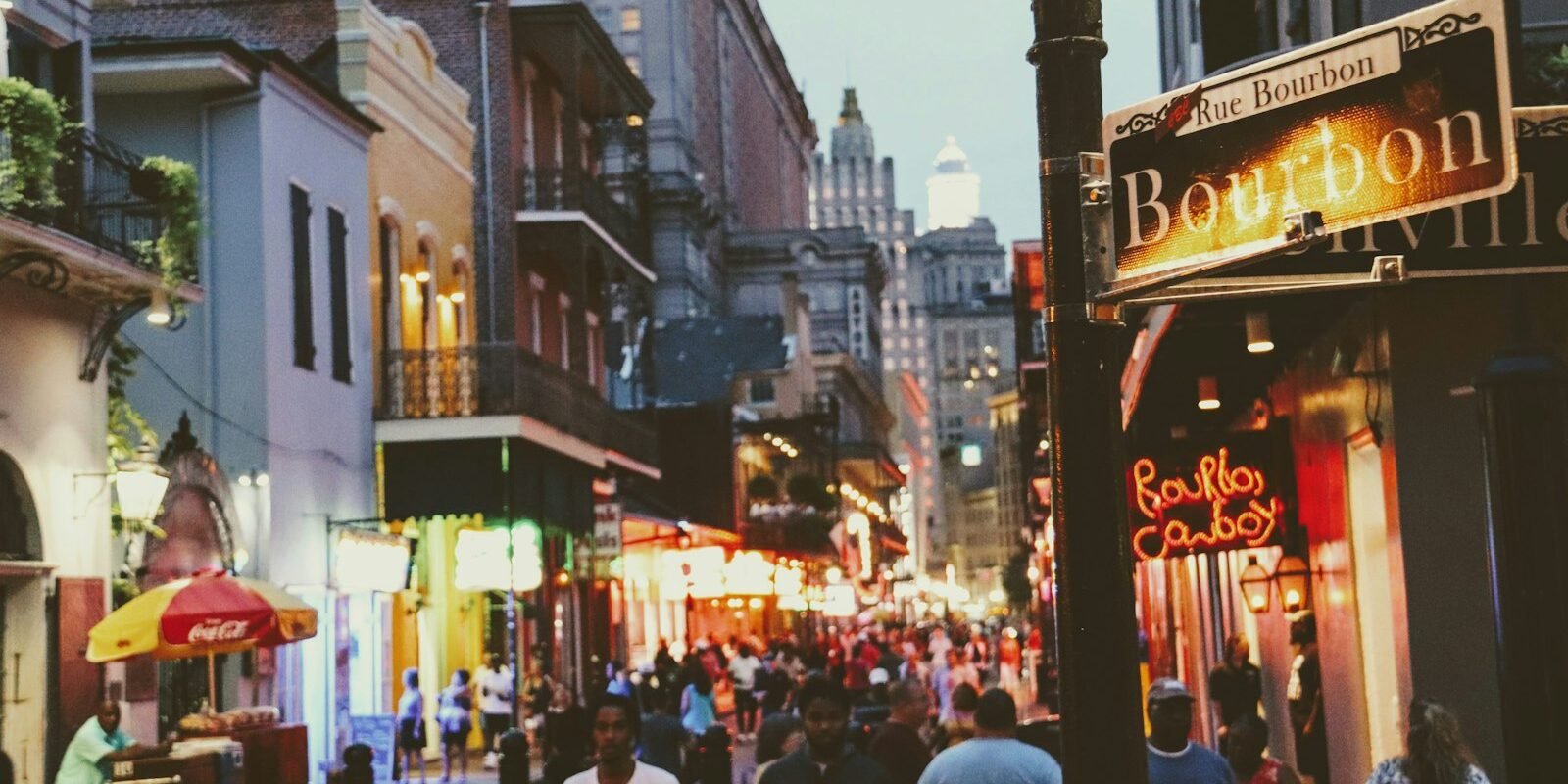
Quick answer: The French Quarter (Vieux Carré) covers about 13 blocks along the Mississippi. See Jackson Square, St. Louis Cathedral, Royal Street by day and Bourbon Street by night, eat beignets at Café du Monde and finish on Frenchmen Street just outside the Quarter.
Despite its name, most of the Quarter’s architecture is Spanish colonial, rebuilt after fires in 1788 and 1794: think courtyards, wrought-iron balconies and pastel facades.
Key streets
- Royal Street: galleries, antiques and street musicians; pedestrian-only by day in parts.
- Bourbon Street: bars, neon and crowds.
- Chartres Street: Jackson Square, the Cabildo and Ursuline Convent.
- Decatur Street: the French Market and Café du Monde.
- Esplanade Avenue: the quiet eastern edge with grand homes.
Sights
- St. Louis Cathedral and the Cabildo museum.
- Pharmacy Museum and the Historic New Orleans Collection.
- Old Ursuline Convent, one of the oldest buildings in the Mississippi Valley.
- Moonwalk riverside promenade.
Where to eat and drink
- Beignets: Café du Monde or Café Beignet.
- Classic Creole: Galatoire’s, Arnaud’s or Antoine’s.
- Cocktails: the Sazerac and Vieux Carré were born here; try the Carousel Bar.
Safety tips
- Stick to busy streets after dark and avoid walking alone late at night.
- Ignore “I bet I can tell you where you got your shoes” hustlers.
FAQ: French Quarter
How long do you need in the French Quarter?
A full day by daylight, plus an evening for music and nightlife.
Is the French Quarter walkable?
Very: it’s compact and flat.
More New Orleans guides
- New Orleans travel guide
- 20 best things to do in New Orleans
- New Orleans itinerary: 2, 3 or 4 days
- Where to stay in New Orleans
- Best time to visit New Orleans
- New Orleans airport to the French Quarter
- Mardi Gras in New Orleans
- New Orleans swamp tours
Plan your trip to New Orleans
The trusted services we use to plan our own trips.