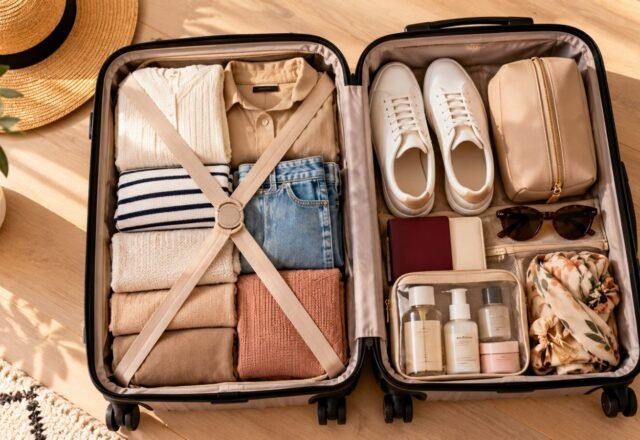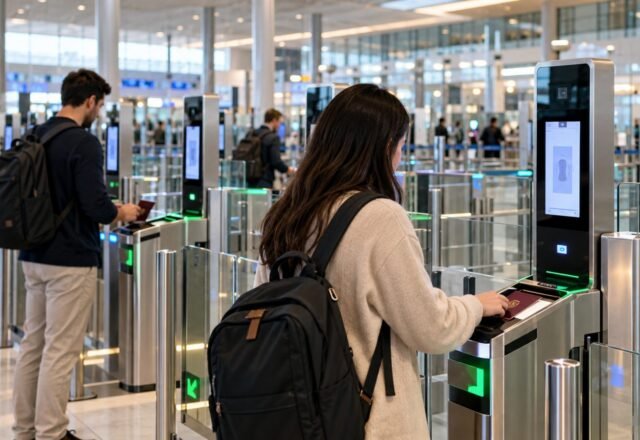
The 100 ml liquids rule has frustrated travellers since 2006. In 2026, it’s finally changing — but only at airports with the new 3D security scanners, which means the rules can be different on your outbound and return flights. This guide explains the current carry-on liquids rules, which airports allow more and how to pack so you never lose your toiletries at security.
Airport lists come from Travel Gossip (March 2026) and Which? (January 2026). Rules can vary by terminal and change quickly — always check your airport’s website before flying.
The standard liquids rule
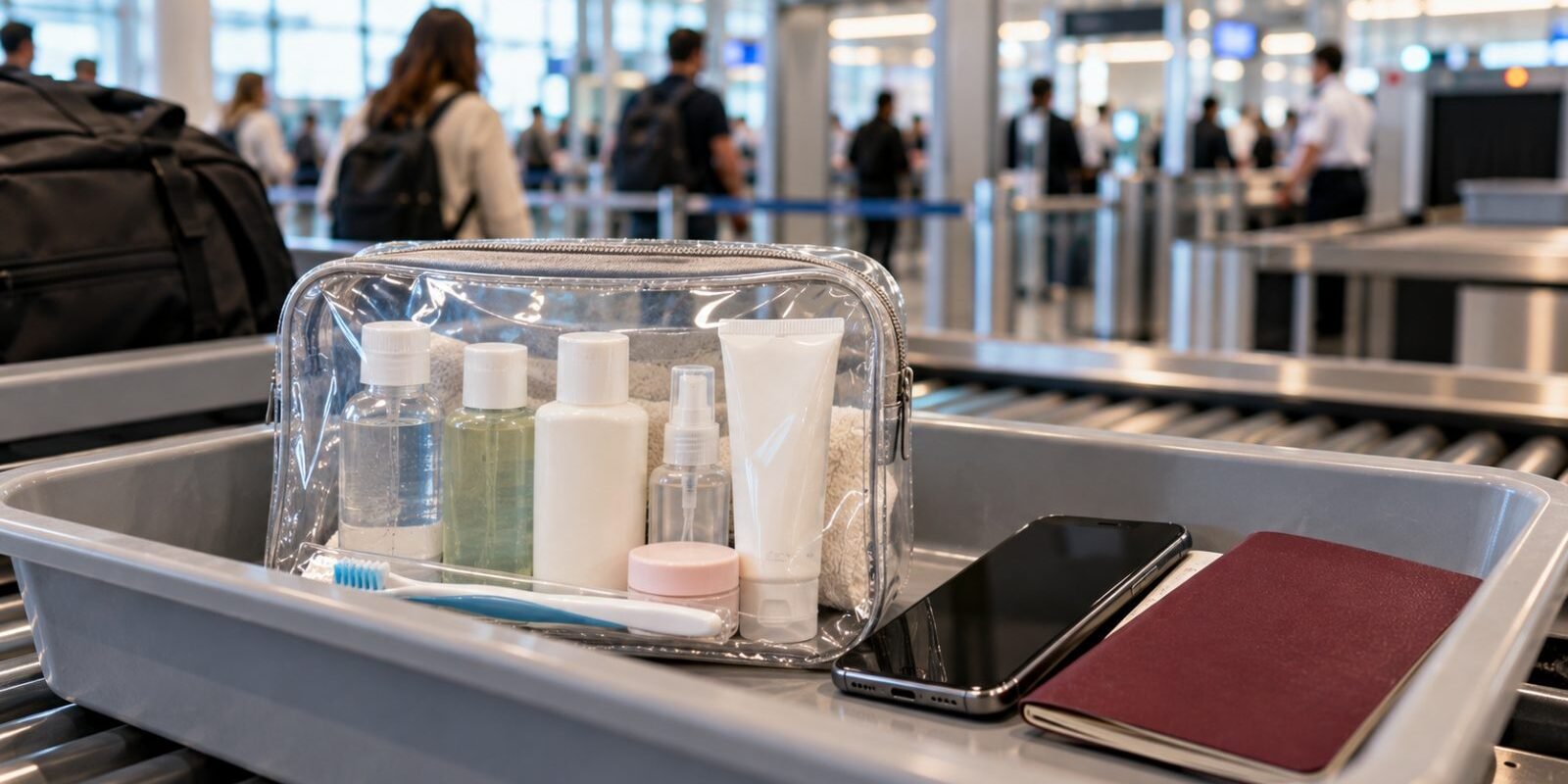
- Containers of 100 ml (3.4 oz) maximum — even if they’re only partly full.
- One clear, resealable plastic bag of about 1 litre (roughly 20 × 20 cm) per passenger.
- Take the bag out of your hand luggage at security.
- Exceptions: essential medicines, baby milk and baby food in reasonable quantities.
What counts as a liquid?
Drinks, water, shampoo, lotions, creams, sunscreen, perfume, toothpaste, mascara and liquid make-up, gels, sprays, pastes — and foods like yoghurt, jam, honey, soup and peanut butter.
Airports allowing up to 2 litres (2026)
| Country | Airports with relaxed rules |
|---|---|
| UK | London Heathrow, London Gatwick, Birmingham, Bristol, Edinburgh, Liverpool, Belfast, Bournemouth |
| Spain | Madrid, Barcelona, Málaga, Palma de Mallorca |
| Italy | Rome Fiumicino, Milan Malpensa |
| Germany | Berlin, Frankfurt, Munich |
| Other | Amsterdam, Dublin, Prague, Helsinki, Malta |
Sources: Travel Gossip, Which?. Relaxed rules may apply only at checkpoints with new scanners.
Airports still applying the 100 ml rule (2026)
Examples include Paris CDG, Nice, Lisbon, Vienna, Zurich, Geneva, Brussels, Copenhagen, Athens, Istanbul, Manchester and Aberdeen (source). If any airport on your itinerary still uses 100 ml, pack to that rule.
The US TSA 3-1-1 rule
- 3.4 oz (100 ml) containers or smaller
- 1 quart-size clear bag
- 1 bag per passenger
Medicines, baby formula and breast milk are allowed in larger quantities — declare them at security.
Practical tips
- Pack for the strictest airport on your trip — your return airport may not have the new scanners (source).
- Use solid toiletries: shampoo bars, solid deodorant and toothpaste tablets don’t count as liquids.
- Buy travel-size bottles and refill them at home.
- Bring an empty water bottle and refill it after security.
- Duty-free liquids are allowed in a sealed security bag with the receipt — keep it sealed if you have a connection.
- Vacuum flasks may need to be empty even at airports with new scanners (source).
- Checked luggage has no 100 ml limit — put large toiletries there.
Liquids for our top destinations
- Madrid: Madrid-Barajas is on the relaxed list in 2026 — but check your departure airport. See our Madrid Airport guide.
- London: Heathrow and Gatwick allow up to 2 litres — see Heathrow to central London.
- Paris: CDG was still applying traditional rules in March 2026 — see CDG to Paris.
More travel tips
- How to find cheap flights
- Do you need travel insurance?
- The ultimate packing checklist
- Travel eSIM guide
- How to book a hotel for less
- Renting a car abroad & IDP
FAQ: Carry-on liquids
Is the 100 ml rule still in place in 2026?
At many airports, yes. Airports with new CT scanners allow containers up to 2 litres; others still apply 100 ml.
Which UK airports allow 2 litres?
In 2026 these include London Heathrow, Gatwick, Birmingham, Bristol, Edinburgh, Liverpool and Belfast. Manchester still applies 100 ml.
Do I still need a plastic bag?
At airports with new scanners often not; elsewhere you need one clear, resealable bag of about 1 litre.
Is toothpaste a liquid?
Yes — pastes, gels and creams count as liquids.
Can I bring medicine over 100 ml?
Yes, essential medicines are allowed — carry a prescription and declare them at security.
What is the TSA 3-1-1 rule?
3.4 oz (100 ml) containers, in one quart-size bag, one bag per passenger.
Book your trip: our favourite tools
The trusted services we use to plan our own trips.
Some links are affiliate links: if you book through them we may earn a commission at no extra cost to you.